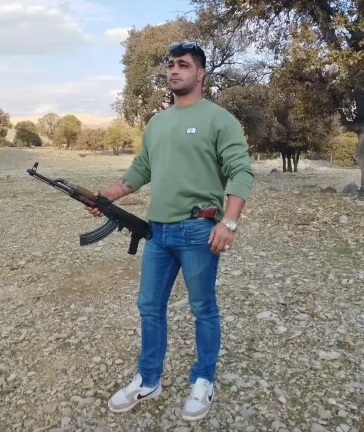
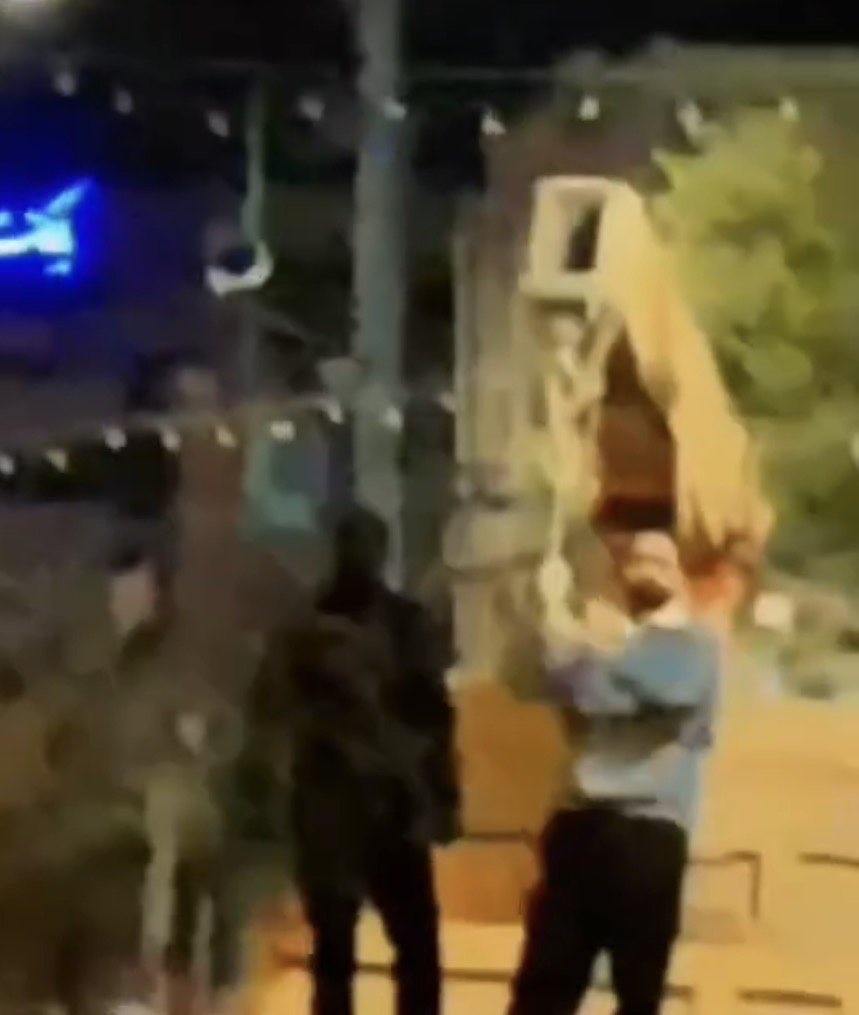
Mahmoud Ansari Publicly Hanged for Murder in Yasuj
Iran Human Rights (IHRNGO); November 10, 2025: Mahmoud Ansari, a man on death row for murder, was publicly hanged in Yasuj. This is the eighth public hanging recorded in 2025.
According to Mizan news agency, a man was publicly hanged in Yasuj on 11 November 2025. The unnamed man was sentenced to qisas (retribution-in-kind) for the murder of a doctor in Yasuj by the Criminal Court.
IHRNGO has verified his identity as Mahmoud Ansari. In the videos of the public hanging published online, he kisses the noose before placing it around his own neck. Mahmoud was hanged by a crane. Public executions are usually performed by a crane in Iran which causes death after several minutes due to suffocation and is considered a form of slow and torturous killing.
Mahmoud Ansari is the eighth person to be publicly hanged in Iran in 2025. Iran is one of the few countries in the world to carry out executions in public spaces. 2021 was the only year in more than a decade that the Islamic Republic did not carry out any public executions, partly due to the COVID-19 pandemic that year. Public executions resumed in 2022 with two people being hanged, and in 2023 the number of public executions rose again to seven. In 2024, four people were executed in public in Iran.
Those charged with the umbrella term of “intentional murder” are sentenced to qisas (retribution-in-kind) regardless of intent or circumstances due to a lack of grading in law. Once a defendant has been convicted, the victim’s family are required to choose between death as retribution, diya (blood money) or forgiveness.
Crucially, while an indicative amount is set by the Judiciary every year, there is no legal limit to how much can be demanded by families of the victims. IHRNGO has recorded many cases where defendants are executed because they cannot afford to pay the blood money. Should the victim’s family choose execution, they are not only encouraged to attend, but also to physically carry out the execution themselves.
According to IHRNGO’s 2024 Annual Report on the Death Penalty, at least 419 people including a juvenile offender and 19 women, were executed for murder charges, the highest number of qisas executions since 2010. Only 12% of the recorded qisas executions were announced by official sources. In 2024, Iran Human Rights also recorded 649 cases of families choosing diya or forgiveness instead of qisas executions. In the first ten months of 2025, at least 568 people were executed for murder charges in Iran.