Amirsalar Davoudi
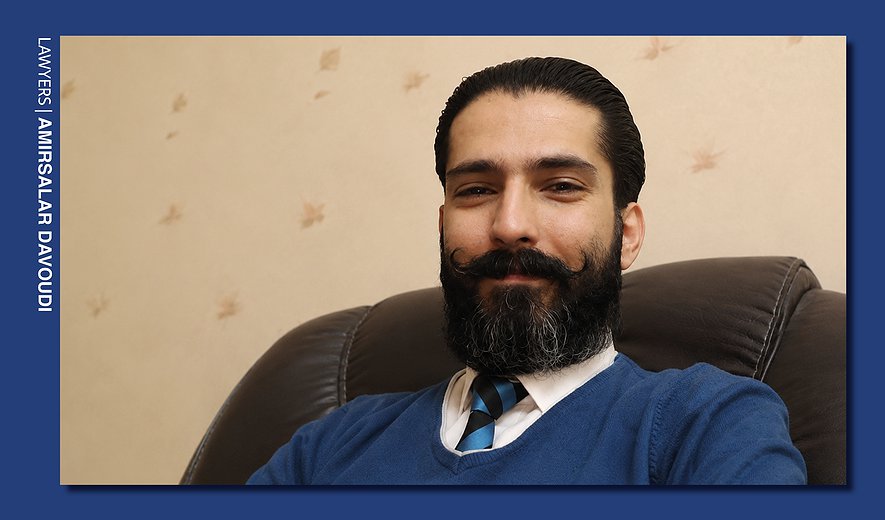
Age: 46
Activism/rights: Lawyer and human rights defender
Status: Imprisoned
Judicial status: Sentenced to 30 years in prison and 111 lashes in a previous case, with enforcement of the sentence suspended; facing prosecution in a new case
Violations: Arbitrary arrest and detention, denial of due process and a fair trial, judicial harassment, torture, denial of medical care, denial of access to legal counsel, prolonged solitary confinement, denial of contact and visits with family members, forced transfer to another prison, interference with the exercise of his professional duties as a lawyer
Amirsalar Davoudi is a lawyer who has represented a number of political prisoners and civil activists, religious converts, and members of the Baha’i community. He was arrested by security forces on 19 November 2018 and transferred to Ward 241 of Evin Prison. Prior to his arrest, security officers had raided his office and home, confiscating a number of his personal files and belongings. He spent 190 days in solitary confinement.
He was arrested in relation to his Telegram channel “Without Retouch,” where he discussed breaches in the judicial process, the judicial harassment of lawyers and human rights abuses. On 1 June 2019, Branch 15 of the Tehran Revolutionary Court presided over by "Death Judge" Salavati, sentenced Amirsalar to 111 lashes and a total of 30 years in prison: 15 years for “forming a group to overthrow the political system (through his Telegram channel), propaganda against the system, publishing lies and insulting officials and the leader”
amongst other charges. The sentence was upheld by the Court of Appeal on 30 July 2019.
On 13 April 2021, Amirsalar was prison-exiled from Evin Prison to Rajai Shahr Prison. His request for a retrial was granted by Branch 41 of the Supreme Court on June 13, and he was released on bail. A month later, Branch 28 of the Tehran Revolutionary Court upheld the original ruling by Branch 15. On 26 June 2022, while Amirsalar was attending the Evin Prosecutor’s Office, he was unexpectedly arrested by order of the judge of Branch One of the Sentence Enforcement Unit and transferred to Ward 4 of Evin Prison. The 2022 Ludovic-Trarieux International Human Rights Award was presented to Amirsalar in absentia on 23 September.
He survived the 15 October 2022 attack on Evin Prison during the “Woman, Life, Freedom” nationwide protests. He was deprived of the right to contact his family for two months due to publishing a post about the “Woman, Life, Freedom” movement.
In February 2024, Amirsalar filed a complaint against three current and former security officials of the Islamic Republic judiciary on charges of “commission of proven disciplinary offences and violations”.
On 2 September 2024, Amirsalar was granted a three-day prison furlough, and the enforcement of his sentence was suspended following the acceptance of his request for a retrial.
On October 4, 2026, Davoudi announced the marriage of two political prisoners, Alireza Sepahi and Mahshad Kashani, by sharing an audio recording of their marriage ceremony on his Instagram account. Sepahi was executed the following day, October 5, at Isfahan Central Prison. Davoudi criticized the judicial proceedings and the implementation of his death sentence.
On October 11, 2026, Davoudi was arrested while attending the Isfahan Revolutionary Court to represent Mahshad Kashani. A new criminal case was opened against him.
On October 13, 2026, Asadollah Jafari, Chief Justice of Isfahan Province, confirmed Davoudi’s arrest and the charges against him. The announced charges included “spreading false information online with the intent to disturb public opinion,” “inciting people to kill one another with the intent to disrupt national security,” and “propaganda against the state.” The judicial official also raised the possibility of an additional charge under the law imposing harsher penalties for espionage and cooperation with Israel, but did not confirm that such a charge had been formally brought against Davoudi. Davoudi was transferred to Isfahan Central Prison after he was unable to post bail.
On October 30, 2026, it emerged that a new case against Amirsalar Davoudi, a lawyer and human rights defender, had been transferred from Branch 18 to Branch 11 of the Investigation Office of the Revolutionary Prosecutor’s Office in Isfahan and assigned to Mohammad Fereydouninejad, an investigating judge against whom Davoudi had previously filed a complaint over the alleged torture and sexual abuse of his clients. The investigation into the alleged torture of Davoudi’s clients was also assigned to the same judge.
On 8 November 2026, Amirsalar Davoudi was transferred from prison to Al-Zahra Hospital in Isfahan after suffering a heart attack. He was unconscious at the time of his transfer and remained under heavy security. Following his discharge from hospital, Davoudi was taken to court to be formally informed of the charges against him. However, the hearing was postponed, and he was returned to prison. In a statement issued on 9 November 2026, Iran Human Rights expressed concern about the lawyer’s health and his lack of access to adequate medical care. Davoudi continues to be denied contact and visits with his family, while his lawyer faces restrictions on accessing his case file.
Since his arrest on October 11, 2026, Davoudi has been denied contact and visits with his family despite an order from the prosecutor. His family and lawyer remain unaware of his whereabouts, although judicial authorities previously stated that he had been transferred to Isfahan Central Prison.
On 12 November 2026, Iran Human Rights announced that three security-related charges had been formally brought against Amirsalar Davoudi. The charges include “propaganda against the state,” “spreading false information through computer systems,” and an offence under Article 4 of the Law on Intensifying Punishments for Espionage. The third charge relates to the publication of an audio recording of the telephone marriage ceremony of two of Davoudi’s clients, Mahshad Kashani and Alireza Sepahi Badjani. If convicted, Davoudi could face a prison sentence of more than 10 to 15 years and permanent disqualification from public and government employment. His lawyer has been denied access to the case file and the evidence supporting the charges.
More from @ihrights
IHRNGO is building a strong civil society, through empowerment of the citizens, promoting and defending the human rights.
Latest Cartoon
Latest Report