Group Hanging of Arezou Rastad, Relatives Saleh and Marat Zeidabadi, and Amir Danayi in Isfahan
Iran Human Rights (IHRNGO); 26 August 2026: Arezou Rastad, Saleh Zeidabadi, Marat Zeidabadi and Amir Danayi were executed in Isfahan Central Prison. Arezou, who was a victim of forced marriage and extreme domestic violence, was convicted of the murder of her husband. Saleh, Marat and Amir’s executions for drug-related offences were secretly carried out, depriving them of last family visits.
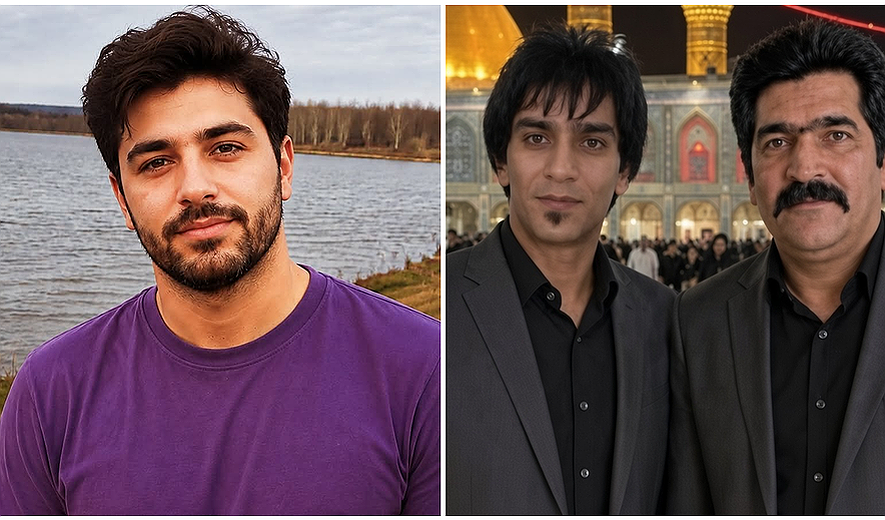
According to information obtained by Iran Human Rights, three men and a woman were executed in Isfahan (Dastgerd) Central Prison on 24 August 2026. Their identities have been established as Arezou Rastad, a 23-year-old woman from Isfahan, 42-year-old Saleh Zeidabadi (right photo) from Fahraj and his nephew, 30-year-old Marat Zeidabadi (middle photo), and 33-year-old Amir Danayi (left photo) from Rasht. Arezou was sentenced to qisas (retribution-in-kind) for murder and the three men were sentenced to death on drug-related charges.
An informed source told IHRNGO: “Arezou was 21 years old at the time of the alleged offence. Aged 19, she was forced by her family to marry her father's cousin, a man 11 years her senior. Their marriage was marked by severe abuse, with her husband repeatedly beating her within an inch of her life. Around two years ago, in a fit of rage, Arezou stabbed her husband to death while he slept. The court ignored both her defence and the documented domestic abuse.”
“Saleh Zeidabadi and his nephew Marat Zeidabadi, were arrested around five years ago on drug charges and sentenced to death. Marat leaves behind two young daughters. Amir Danayi was arrested four years ago on drug charges and sentenced to death by the Revolutionary Court. All three men were executed by Isfahan Prison authorities without prior notification to their families and without being permitted a final visit,” the source added.
At the time of writing, their executions have not been reported by domestic media or officials in Iran.
Arezou Rastad is the seventeenth woman execution recorded in 2026. In 2025, at least 48 women were executed, the highest number of women executions recorded in Iran in more than two decades. Iran executes the highest recorded number of women globally.
In January 2025, IHRNGO published a report titled “Women and the Death Penalty in Iran; a Gendered Perspective,” which sheds light on the contemporary experiences of women facing the death penalty, focusing on the discriminatory laws and societal factors that perpetuate their suffering.
Drug-related executions have continuously risen every year since 2021. According to IHRNGO’s 2025 Annual Report on the Death Penalty, at least 795 people were executed for drug-related charges, of which only 0.18% were announced by official sources. 13% of all drug-related executions in 2025 were Baluch minorities while they represent 2-6% of Iran’s population.
In December 2025, IHRNGO published a report titled “A Village of Graves: Widespread and Systematic Drug Executions in Iran,” which provides an overview of drug laws and documents the systematic violation of due process and fair trial rights in drug cases.
More from @ihrights
IHRNGO is building a strong civil society, through empowerment of the citizens, promoting and defending the human rights.
Latest Cartoon
Latest Report