Reza Khandan
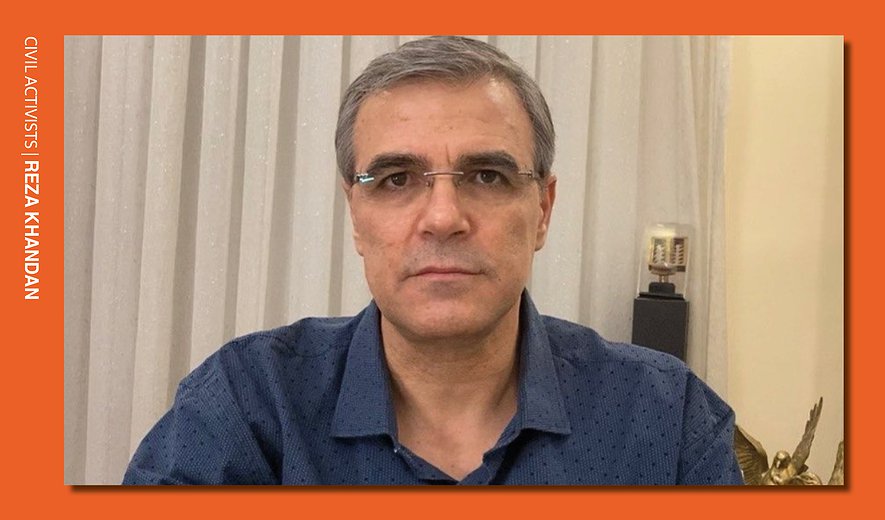
Age: 61
Field of Activity: Civil Rights Activist, Opponent of Compulsory Hijab and the Death Penalty
Status: Imprisoned in Evin Prison
Legal Status: 4 years, 1 month, and 16 days in prison
Violations: Arbitrary arrest, denial of a fair trial, denial of family visits, detention in poor prison conditions, harassment of family members
Reza Khandan, a civil activist who together with Farhad Meysami produced and distributed thousands of badges bearing the slogan “I Protest Against Mandatory Hijab” in 2018. This led to his arrest at his home on 4 September 2018. Reza, who had been released on bail on 23 December of the same year, was one month later sentenced by Branch 15 of the Revolutionary Court of Tehran, presided over by Abolqasem Salavati, to six years’ imprisonment and bans on membership in political parties and groups, activities in cyberspace, media and press activities, and leaving the country, on charges of “assembly and collusion with intent to commit crimes against national security” and “propaganda against the system”. Following the acceptance of his request for retrial by the Supreme Court, this sentence was reduced to four years, one month and 16 days’ imprisonment. Security forces again arrested him at his home on 14 December 2024. Nasrin Sotoudeh, a human rights lawyer and Khandan’s wife, described the arrest as unlawful and stated that he had previously been granted amnesty and that his case had been closed. Mahmoud Behzadi-Rad, Khandan’s lawyer, also stated that the Ministry of Intelligence, as the investigating authority in the case, had previously opposed the enforcement of this sentence. On 23 December 2024, this civil activist was transferred from the prison quarantine ward to Ward 8 of Evin Prison. According to his wife, Ward 8 is infested with bedbugs, prisoners sleep on the floor with a single blanket, and access to telephone calls is limited. On 24 December 2024, Reza Khandan began a hunger strike in protest against his transfer and the inhumane conditions in Ward 8, as well as the death of Mehdi Khodayari, a political activist, in police custody. Six days later, he ended his hunger strike following assurances by officials that conditions would improve.
Reza Khandan has repeatedly been denied visits with his wife and daughter, Mehraveh, on the pretext that they did not comply with the hijab requirement in prison. Mehraveh was forced to leave Iran due to pressure by the authorities on the family. His son, Nima, was beaten by prison officials during a visit with his father on 29 January 2025 and was arrested. His grandmother, who was accompanying him, lost consciousness and was transferred to hospital. Following this incident, Reza went on hunger strike in protest against the beating of his son and the ban on family visits. Officials transferred him from Ward 8 of Evin Prison to the quarantine ward. A few days later, due to the psychological pressure this caused on his children, he ended his hunger strike. Following the Israeli attack on Evin Prison on 23 June 2025, Reza, in a report from Greater Tehran Prison entitled “Report of a Crime”, described the violent and unlawful nighttime transfer of hundreds of prisoners in handcuffs and shackles, under threat of weapons, from Evin Prison to Greater Tehran Penitentiary. In August 2025, they were violently transferred back to Evin Prison. In November 2025, Reza announced that, due to being denied visits with his wife and daughter for 10 months on the pretext of “non-compliance with hijab”, he had for about one month been staging a daily sit-in in front of the office of Ward 7 of the prison in protest.
On 1 April 2026, his daughter, Mehraveh Khandan, stated that his life and the lives of other prisoners were in serious danger due to wartime conditions and the authorities’ practice of “welding shut the ward doors”.
On September 22, 2026, Nasrin Sotoudeh stated that Evin Prison authorities had prevented her from visiting Reza Khandan for the 100th time because of her refusal to comply with mandatory hijab regulations. The denial of visitation continued while Khandan remained imprisoned at Evin Prison.
On October 16, 2026, Nasrin Sotoudeh revealed that Reza Khandan had been granted amnesty twice without having requested it, but security and judicial authorities had blocked its implementation on both occasions. She also stated that three new judicial cases had been opened against him during his imprisonment, involving charges including “spreading false information” and “propaganda against the state.”
More from @ihrights
IHRNGO is building a strong civil society, through empowerment of the citizens, promoting and defending the human rights.
Latest Cartoon
Latest Report