Azimi: Defending life must transcend political divisions
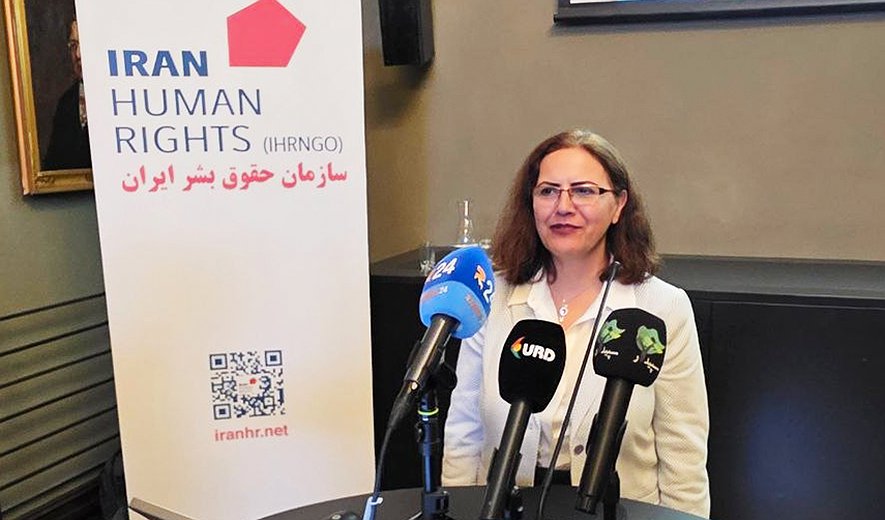
Farzaneh Azimi, a representative of the Left Party of Iran, called for joint action against the death penalty at the Oslo conference “Iran’s Human Rights Crisis: From Shared Principles to Joint Action”. “In defending life, political divisions must fade,” she said. “Any political party or organisation that opposes taking human life should be able to act alongside others.”
According to Iran Human Rights (IHRNGO), Azimi argued that agreement on human rights principles was insufficient unless it led to practical cooperation. Defending the right to life and campaigning to abolish the death penalty, she said, offered a common purpose around which Iran’s democratic and pro-freedom political groups could unite.
The conference, held in Oslo on 25–26 September 2026, brought together representatives of political parties and organisations. Organised and hosted by IHRNGO, it was the sixth event in its “Iran and the Transition from Authoritarianism” conference series.
Azimi thanked the organisers for preparing a document setting out minimum human rights principles for the transition. She also honoured those who had lost their lives in the struggle for freedom over nearly five decades, recalling imprisonment, torture, executions and the killing of protesters in the streets.
Most political groups now accepted the principles of the Universal Declaration of Human Rights, she said. Acting together to defend them was another matter. “Experience has shown that the opposition does not act solely on the basis of shared beliefs and principles.”
Citing figures from Iranian and international human rights organisations, Azimi described a continuing deterioration in Iran’s human rights record and a rise in executions. “Whenever the Islamic Republic faces political, social and economic crises, it resorts ever more heavily to repression and executions.”
Opposition to the death penalty should provide grounds for cooperation across political divides. “The struggle for human rights, including the right to life and opposition to executions, must not remain trapped within political, ideological and organisational divisions.” The broader and better organised that solidarity became, she argued, the greater its chances of pushing back against repression and executions.
Declarations alone, however, offered no guarantee of action. In the summer of 2023, the Left Party of Iran had joined more than 30 political organisations in signing the “Covenant for the Right to Life”. That agreement had failed to produce joint action. Azimi hoped the new document would lead to practical cooperation wherever possible.
She identified several areas for such work: securing the release of political prisoners; opposing imprisonment, torture and executions; defending women’s rights; combating gender discrimination; and protecting ethnic minorities and people facing discrimination because of their religion or beliefs. Political and civil liberties, she stressed, belonged to everyone, regardless of belief, religion, nationality or gender.
The signatories’ commitment should also be evident in their own conduct, public statements and political programmes. Azimi then turned to the obstacles that had repeatedly prevented agreement in principle from becoming cooperation in practice.
One was the habit of allowing differences to overshadow common ground. “When faced with a practical initiative, the Iranian opposition starts, first and foremost, with its disagreements.” Rather than let those disagreements dictate the outcome, she urged groups to identify feasible projects on which they could agree and build cooperation around them.
Past relationships and longstanding intellectual and political divisions posed another obstacle. In the absence of political freedom, differences could harden into collective identities, while judgements based on political pedigree made dialogue more difficult. Joint action could help overcome that distrust and lay the foundations for sustained cooperation.
Disputes over urgent questions, including war, could be more disruptive still. They could undermine agreement on shared principles or even prevent political groups from sitting down together.
Success therefore required more than endorsing a document. “Political groups must uphold these principles in their daily activities, their decisions and their relations with one another and with their political opponents.”
Azimi called for continued respect for pluralism and cooperation despite political differences. “Our movement is harmed not only by the Islamic Republic’s religious tyranny and the repression it produces, but also by the opposition’s own disunity and fragmentation.”
She hoped the signing would help build greater solidarity, end religious tyranny, eliminate discrimination and secure the rights of every citizen.
Translated from Farsi via machine translation and lightly edited for clarity.
More from @ihrights
IHRNGO is building a strong civil society, through empowerment of the citizens, promoting and defending the human rights.
Latest Cartoon
Latest Report