Shameli: Iran’s next constitution must recognise the right to regional self-government
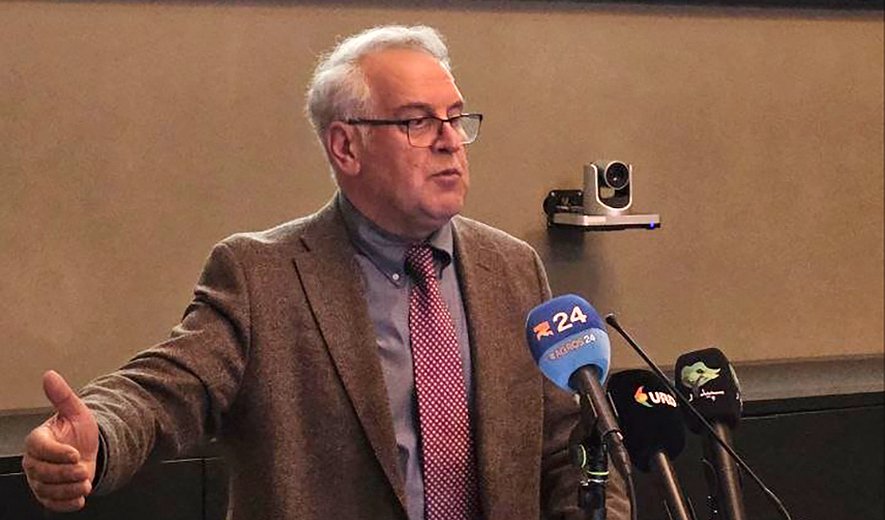
Younes Shameli, a representative of the Azerbaijan Democratic Party, called for regional self-government at the Oslo conference “Iran’s Human Rights Crisis: From Shared Principles to Joint Action”. “Iran’s system of government must be multicultural, multinational and democratic,” he said. “It must encompass all the peoples of Iran and recognise their right to govern their own regions.”
According to Iran Human Rights (IHRNGO), Shameli focused on the relationship between human rights during the transition and Iran’s future political structure. Held in Oslo on 25–26 September 2026, the conference brought together representatives of political parties and organisations. Organised and hosted by IHRNGO, it was the sixth event in its “Iran and the Transition from Authoritarianism” series.
Shameli argued that the transition could not be considered separately from the constitutional settlement that followed. “Iran’s future will be determined not by the transition itself, but by that constitution.” A constitution did not deserve acceptance simply because it had been drafted and adopted. Recalling the experience of the 1979 revolution, he stressed the need to scrutinise its substance and resist any return to authoritarian rule.
He described the present situation as “neither war nor peace”. The issues behind the war remained unresolved, while further complications had emerged. With Iran facing the prospect of substantial political change, political groups needed to prepare for the transition.
Agreement on human rights principles, and efforts to promote them, were essential to preventing violence, he said. The absence of free political parties and open debate had held back public political awareness. “At any moment, and for any reason, appalling violence could erupt in Iran.”
The outlook of political parties and individual leaders would help determine the course of the transition. Without clear positions on women’s rights, social justice, workers, the environment and capital punishment, past failures could recur. Shameli also criticised sections of the opposition that continued to advocate executions.
He identified the national question as a particularly contentious issue within the opposition. “Iran is a multinational and multilingual society. Without a solution to this question, we will face serious difficulties, because the disagreements are substantial.”
Shameli drew on two sources for a possible answer: Iran’s own constitutional history and international experience of decentralised government. He cited the provincial and district councils envisaged during the Constitutional Revolution as an early recognition of regional self-government. “The right to govern one’s own region was recognised in Iran’s political and legal history as early as the first constitution.”
Drawing on federal systems in countries including America, Canada, Germany and India, he argued that regional self-government should not be treated solely as a demand by national and ethnic groups. It concerned development across the country. “Do Isfahan, Fars and Khorasan not also want to work for their own regional development?”
He also called for a review of provincial boundaries when conditions allowed. Citing educational deprivation in Lorestan and Baluchistan, he criticised the concentration of decision-making in Tehran. A governor appointed rather than elected by local people, he argued, answered to the appointing authority. “This system must be fundamentally transformed.”
Shameli distinguished between democracy built from above and democracy built from below. In the former, a powerful central government granted regions greater authority at its own discretion. “Democracy from below rests on the right to regional self-government. That is also the natural process by which power takes shape.”
Political crises and conflict could delay the formation of a constituent assembly, he warned. Should people in the regions wait for a provisional government in Tehran to decide their affairs until a constitution was written? He proposed temporary local institutions to maintain security and public services, followed by elections to establish regional legislatures and governments. He also outlined a bicameral system representing both citizens and regional governments.
Towards the end of his address, Shameli warned that the dominance of what he called Persian nationalism posed a serious threat to the next constitution. He urged democratic groups to work together to prevent it. The existing human rights agreement was vital, he said, but needed a political vision and guarantees of regional self-government to give it substance.
He concluded by presenting Iran’s national and cultural diversity as a source of regional opportunity. “Iran is, in effect, a bridge connecting all these peoples and states.” He expressed hope for a future founded on democracy, decentralisation and democratic federalism.
Translated from Farsi via machine translation and lightly edited for clarity.
More from @ihrights
IHRNGO is building a strong civil society, through empowerment of the citizens, promoting and defending the human rights.
Latest Cartoon
Latest Report