January Protesters Majid Nikandish and Ali Hemati-Sistani Hanged in Mashhad
Iran Human Rights (IHRNGO); 30 September 2026: State media reported the executions of Majid Nikandish and Ali Hemati-Sistani, two men arrested in connection with the 8 and 9 January protests in Mashhad, at an undisclosed location.
Since 18 March, at least 33 protesters (31 in connection with the January protests and two in connection with the “Woman, Life, Freedom” protests) and 13 political prisoners affiliated with banned opposition groups have been executed.
Condemning the executions in the strongest terms, IHRNGO once again urges the international community to place the human rights situation, particularly the use of the death penalty as a tool of political repression, at the top of its agenda in negotiations and meetings with the Islamic Republic.
Mahmood Amiry-Moghaddam, director of the organisation stated: “Ali Hemati and Majid Nikandish were convicted on the basis of torture-tainted confessions in proceedings that failed to meet minimum fair trial standards. Their executions, like those of other protesters, constitute extrajudicial killings, and those who ordered and carried out these crimes must be held accountable.”
Referring to the wave of executions of protesters and political prisoners in recent months, he said: “The execution of this number of protesters and political prisoners in such a short period of time is unprecedented since the 1980s. More than 100 protesters are currently at risk of execution, while hundreds more face the possibility of being sentenced to death. The international community must act immediately, using all available diplomatic tools, to halt this wave of executions and suspend the implementation of the death penalty in Iran.”
According to the judiciary’s Mizan News Agency, Majid Nikandish (left photo) and Ali Hemati-Sistani (right photo), two men arrested in connection with the 8 and 9 January protests in Mashhad, were hanged at an undisclosed location on 30 September 2026. As the protesters were detained in Mashhad (Vakil Abad) Central Prison, it is highly probable that their execution took place at the prison.
According to information obtained by IHRNGO, Majid Nikandish was a 23-year-old Kurdish man from Ghouchan and Ali Hemati was 33 and a Mashhad native.
An informed source told IHRNGO: “Majid was held in solitary confinement for approximately three months. He was subjected to severe torture during interrogations that resulted in a broken jaw and a dislocated shoulder after being suspended by his arms. He was later held alongside seven other prisoners in a designated security room within the prison Although he spent a period in Ward 4, he was transferred to the prison’s security ward for two months before being returned to the same security room.”
Ali and Majid were sentenced to death by Branch 1 of the Mashhad Revolutionary Court, which was subsequently upheld by Branch 39 of the Supreme Court. As all protest cases are considered matters of national security, defendants are systematically denied access to lawyers of their choosing and must instead choose a lawyer from a government-approved list per the Note to Article 48 of the Code of Criminal Procedure (CCP). On 16 May, IHRNGO warned that the Islamic Republic's judiciary is actively weaponising these state-approved lawyers to facilitate and expedite the execution of arrested protesters.
“Majid denied being a protest leader, maintaining that he was merely present with the public and had killed no one,” the source added.
The Mizan report does not name the exact charges used to convict the protesters. According to the report, Ali Hemati-Sistani and Majid Nikandish were accused of acting as leaders during the protests in the Tabarsi district of Mashhad on 8 and 9 January 2026. Although the report broadly attributed the killing of four security personnel to the wider unrest, the specific allegations and confessions detailed against the two men pertained only to stabbing two Basij officers twice in the side, with no evidence presented to establish that these specific injuries were fatal. They were further alleged to have orchestrated widespread arson by throwing Molotov cocktails at a chain store, setting fire to a bank, burning public buses and trees and dumping soil from a lorry to block traffic. Furthermore, they were accused of looting commercial goods recovered during a search of Ali’s residence, whilst Majid was charged with filming protest footage to send to contacts abroad. According to the state report, both men were sentenced to death based on confessions extracted during interrogation.
Majid and Ali’s torture-tainted confessions were aired by the Islamic Republic of Iran Broadcasting (IRIB) shortly after the announcement of their executions.
In the propaganda video, authorities claim: “[during] the January coup, next to these concrete blocks, the terrorists martyred four security personnel. Three of them were arrested, tried and executed [images of Ebrahim Dolatabadinejad, Mehdi Rasouli and Mohammadreza Miri’s forced confessions]. And now it is the turn for the punishment of two others: Ali Hemati and Majid Nikandish."
In another scene, recorded during a forced crime re-enactment, Ali states under interrogation that he stabbed an officer three times in the side, whilst alleging that Majid struck another officer four or five times in the side and back. This directly contradicts the written account published by Mizan News Agency, which asserted that each man had stabbed an officer twice. Moreover, Ali explicitly states in the broadcast that both victims were alive when an ambulance arrived to transport them from the scene, casting further doubt on the state’s unevidenced claims attributing the fatalities directly to their actions.
At the end of the video, the narrator states that the Tabarsi case “remains open until the identification and punishment of all perpetrators.” This indicates that the authorities intend to use this sweeping case to target and potentially execute additional protesters.
Majid Nikandish was among 100 protesters identified as being at risk of execution in a report published by IHRNGO on 14 September.
At least 31 protesters have been executed in connection to the December 2025–January 2026 protests since 19 March, listed here in order of execution: Saleh Mohammadi, Saeed Davodi, Mehdi Ghasemi, Amirhossein Hatami, Mohammad Amin Biglari, Shahin Vahedparast Kolor, Ali Fahim, Amir Ali Mir Jafari, Erfan Kiani, Sasan Azadvar, Ebrahim Dolatabadnejad, Mehdi Rasouli, Mohammadreza Miri, Mohammad Abbasi, Abbas Akbari Feizabadi, Ashkan Maleki, Mehrdad Mohammadinia, Fathollah Avari, Javad Zamani, Abolfazl Saedi, Mohammad Amini Dehaghani, Erfan Esfandiari, Gol Mohammad Mohammadi, Mehdi Khanaki, Abolfazl Sepahi Badjani, Amirhossein Safari Hosseinabadi, Shahram Sadeghi, Ghaem Hosseini, Majid Adineh, Majid Nikandish and Ali Hemati-Sistani.
Mehrab Abdollahzadeh and Aref Khoshkar, two “Woman, Life, Freedom” protesters, were also executed during this period.
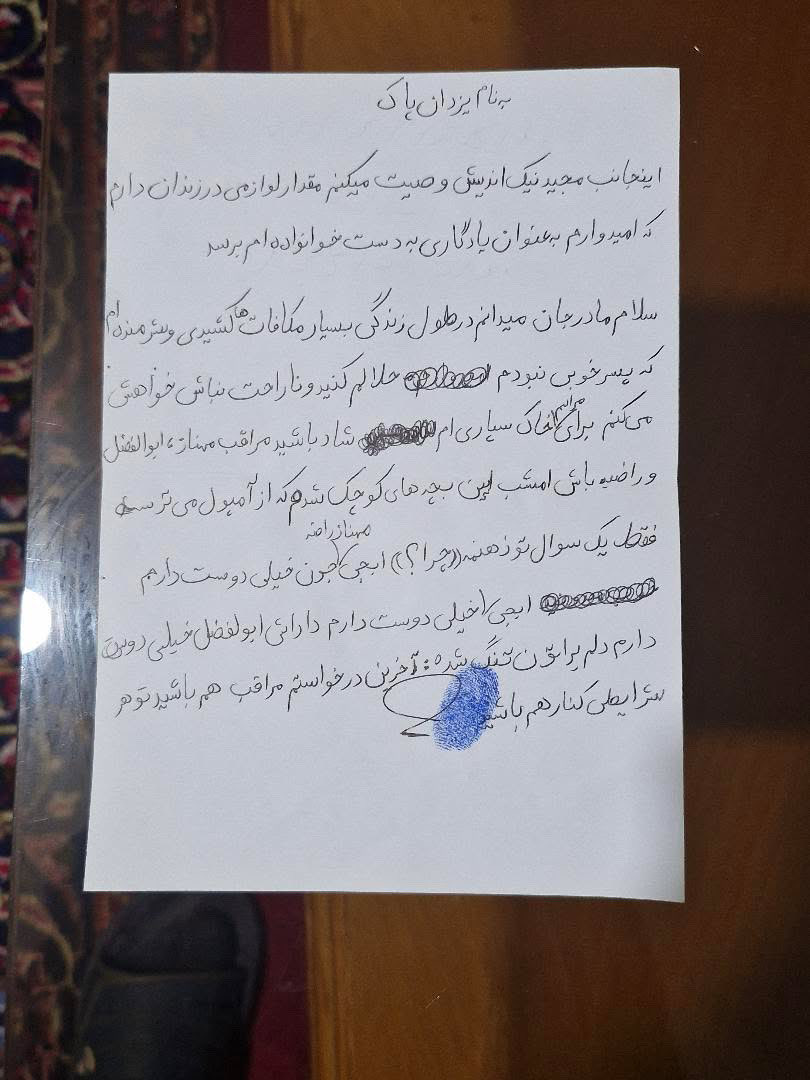
Added on 16 October 2026: The handwritten will of Majid Nikandish, sent from prison following his execution:
In the name of the immaculate creator,
I, Majid Nikandish, declare as my last will that I have a few personal belongings in prison which I hope will reach my family as keepsakes.
Hello, dearest mother, I know that throughout [your] life you endured great hardship and I’m ashamed that I wasn’t a good son. Please forgive me and don’t be sorrowful. I beg you, be joyful at my funeral. Look after Mahnaz, Abolfazl and Razieh.
Tonight, I’ve become like a little child terrified of an injection. Only one question remains in my mind: “why”?
Sis Mahnaz, dear Razieh, I love you so much. I love you so much sis. Brother Abolfazl I love you so much. I miss you all. My last request: look after each other and stand together whatever the circumstances.
(Signature and fingerprint)